
Can the Circular Economy Be Sustained in Waste Management?
For many businesses, waste has traditionally been treated as an unavoidable cost: something produced, collected and removed from site. But as sustainability expectations rise, disposal costs increase and customers ask for stronger environmental evidence, that way of thinking is becoming outdated.
The circular economy offers a different approach. Instead of following the old linear model of “take, make, use and dispose”, it focuses on keeping materials in use for as long as possible, recovering value from resources and reducing what is lost to landfill or low-value disposal. In waste management, this means asking a more commercially useful question: how much of this material can be reused, recycled, recovered or redirected back into value?
Is circular economy sustainable in waste management?
Yes – but only when it is practical, measurable and built into day-to-day operations. Circular economy is not sustained by good intentions alone. It needs the right waste streams identified, the right containers and collections in place, clear segregation on site, reliable recycling routes and accurate reporting.
For businesses, this is where waste management becomes more than a collection service. It becomes a resource strategy. When materials are separated correctly, contamination is reduced and recyclable materials are protected, they are more likely to retain value. That value might come through reduced disposal costs, improved recycling performance, rebate opportunities or stronger environmental data for tenders, audits and ESG reporting.
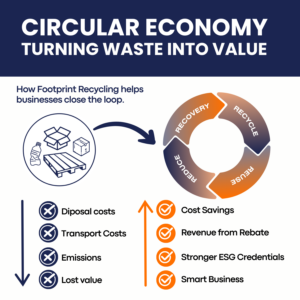
The benefits for businesses
A circular approach to waste can deliver benefits across cost, compliance, sustainability and reputation.
First, it helps reduce waste-related costs. Sending everything into a general waste stream is often expensive and inefficient. By separating materials such as cardboard, plastics, metals, wood, textiles or other recyclable streams, businesses can reduce the volume of residual waste and improve the commercial outcome of their collections.
Second, it can create new value. Some materials may have rebate potential when they are clean, consistent and collected in the right way. Even where rebates are not available, keeping materials out of landfill can still protect margin by reducing disposal costs and improving operational efficiency.
Third, circular waste management supports ESG and sustainability goals. Many organisations are now expected to show evidence of responsible waste handling, recycling performance, carbon-conscious decision making and progress towards zero waste to landfill. Good waste data can help businesses demonstrate these commitments clearly to customers, procurement teams and internal stakeholders. With new regulations, change, and progress, 2026 marks the transition from policy rollout to full enforcement, with new rules designed to boost recycling, increase transparency, and drive sustainability. (Read more)
Finally, it supports compliance and risk reduction. UK businesses have a duty of care for their waste, meaning they must ensure it is handled safely, responsibly and by authorised operators. A structured approach helps businesses understand where waste goes, how it is treated and what evidence is available to support responsible management.
How circular waste management can be achieved
The first step is understanding what is currently being produced. A waste review or audit can identify the main waste streams, current disposal routes, contamination issues and missed recovery opportunities. From there, businesses can prioritise the materials with the greatest potential for cost reduction, recycling improvement or value recovery.
The next step is segregation. Circular economy depends on keeping materials as clean and usable as possible. That may mean clearer internal processes, better signage, staff communication, the right containers in the right locations and collection schedules that match operational needs.
Businesses also need reliable routes for recovered materials. Circularity only works when materials are sent to appropriate recycling, reuse or recovery channels. This is where choosing the right waste management partner makes a major difference.
Why partner with Footprint Recycling?
At Footprint Recycling, we help businesses move beyond simply “getting rid” of waste. We work with organisations to identify what can be reduced, separated, recovered and kept in use for longer. Our approach is designed to support practical circular economy outcomes: reducing what leaves site as residual waste, improving material recovery, helping businesses work towards zero waste to landfill and providing the data needed to support sustainability reporting.
Whether a business is looking to reduce costs, improve ESG performance, strengthen tender responses or build a clearer sustainability story, circular waste management is achievable with the right partner and the right plan.
The circular economy is not about perfection overnight. It is about making better decisions with the materials already moving through your business. With the right systems in place, waste can become less of an expense and more of an asset.
Ready to find out what value is hidden in your waste? Speak to Footprint Recycling about building a more circular, cost-effective and sustainable waste management strategy.